Heeling in chestnuts

JohnL48

Well-Known Member
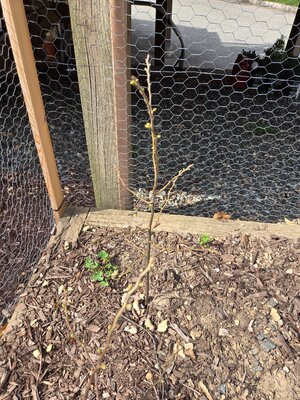
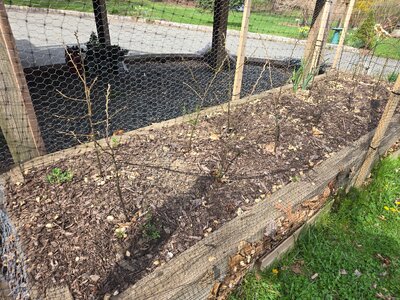
This is the second yr these chestnut saplings are heeled in. They are buried in 2 gallon cloth bags and are really thriving. My question is should I put them in soon or keep buried til fall ? They are going on my property in Southern Catskills in NY 2 hrs away from me
 

Attachments

  • 20260416_152806.jpg
    20260416_152806.jpg
    3.4 MB · Views: 5
  • 20260416_152801.jpg
    20260416_152801.jpg
    4 MB · Views: 4
It depends on the bags. If they are rootmaker bags (or similar root pruning brand), you will get better growth and root development by giving them another growing season of TLC. It also depends on the size of the bag. Typically, with a root pruning system, you will want to do a transplant to a larger container when the roots fill the current one.

If they are not root pruning bags, I would have transplanted them before they broke dormancy. Bare root trees typically have a year of sleep, one of creep, and finally they leap in the third year. This is due to the shock of transplant. Typically you only want to transplant them when dormant. When using a root pruning container system, you don't have this issue and as long as they get sufficient water, you can transplant when they are actively growing. This is because, the root system is undisturbed when planted from a container like an RB2, so the trees have much less transplant shock and will continue to grow without the Sleep/Creep/Leap cycle.
 
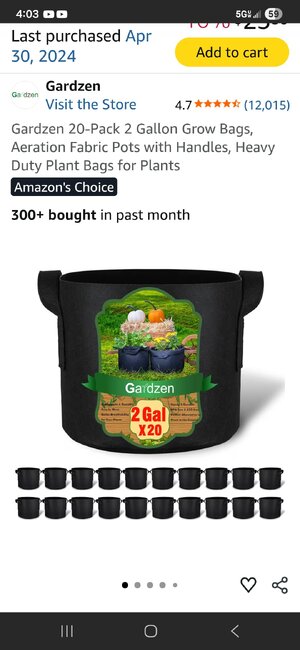
Thank you. These are the bags I'm using. Better to keep in the ground until fall then after the leaves fall ? I can also transfer into root maker pots and let sit til fall or next spring ? Any advice will help. I won't be up every week to water them if that's a factor
 

Attachments

  • Screenshot_20260416_160359_DuckDuckGo.jpg
    Screenshot_20260416_160359_DuckDuckGo.jpg
    232.1 KB · Views: 4
Last edited:
If those bags are buried in the ground, I doubt they are effective at root pruning. There are many ways to grow trees. A root pruning system is one. The benefit of root pruning is that it generates a root system with many terminal roots which increases the efficiency of the uptake of water and nutrients. Because roots pruned (either air pruned as with above ground containers or with constriction using in ground bags), the energy that would otherwise go into a tap root goes both into top growth and root development.

Nothing is free. The downside of a root pruning system is that you don't get a tap root. So, in arid environments, where trees need to have deep roots to get beyond the soils that dry out, trees can die. In my environment, root pruned trees do well, so that is where most of my experience is.

I sold all my root pruning containers a few years ago when I finished up with my major tree project at the farm. I now just dabble. I tried a form of direct seeding last year. I cold stratified and germinated chestnuts in the spring in a 5 gal bucket full of medium and peatmoss. Before the roots hit the bottom or entangled, I directly planted these seedlings in their final location. They are near my retirement home, not the farm, so I could provide TLC. They all survived, but are growing much slower than the chestnuts I grew in the past in rootmakers.

My thoughts, for what they are worth, are to just let your trees grow where they are this year since they broke dormancy. I would wait until they go dormant before transplanting to the final location. When you transplant, I would check to make sure you don't have any j-hooking or circling roots in those bags. Trees with these may look great when young but don't do well in the long run. If you have j-hooking or circling, I would manually prune them and treat them like bare root trees.
 
If those bags are buried in the ground, I doubt they are effective at root pruning. There are many ways to grow trees. A root pruning system is one. The benefit of root pruning is that it generates a root system with many terminal roots which increases the efficiency of the uptake of water and nutrients. Because roots pruned (either air pruned as with above ground containers or with constriction using in ground bags), the energy that would otherwise go into a tap root goes both into top growth and root development.

Nothing is free. The downside of a root pruning system is that you don't get a tap root. So, in arid environments, where trees need to have deep roots to get beyond the soils that dry out, trees can die. In my environment, root pruned trees do well, so that is where most of my experience is.

I sold all my root pruning containers a few years ago when I finished up with my major tree project at the farm. I now just dabble. I tried a form of direct seeding last year. I cold stratified and germinated chestnuts in the spring in a 5 gal bucket full of medium and peatmoss. Before the roots hit the bottom or entangled, I directly planted these seedlings in their final location. They are near my retirement home, not the farm, so I could provide TLC. They all survived, but are growing much slower than the chestnuts I grew in the past in rootmakers.

My thoughts, for what they are worth, are to just let your trees grow where they are this year since they broke dormancy. I would wait until they go dormant before transplanting to the final location. When you transplant, I would check to make sure you don't have any j-hooking or circling roots in those bags. Trees with these may look great when young but don't do well in the long run. If you have j-hooking or circling, I would manually prune them and treat them like bare root trees.
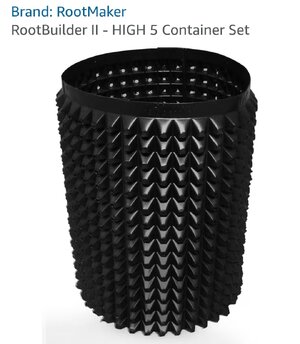
Is there a way of keeping these with me a few yrs to take care of them and let them grow if I planted in the rootbuilder 2 containers ?
 

Attachments

  • Screenshot_20260416_164149_DuckDuckGo.jpg
    Screenshot_20260416_164149_DuckDuckGo.jpg
    115.6 KB · Views: 3
Yes, but you probably won't get the maximum benefit of root pruning. The concept of root pruning is that when pruned, it causes roots to produce lateral branching roots. Most of these occur in the first 4" upstream of the prune. So, typically chestnuts are started in 18s. These prune the tap root at the right point. These are good for the first 12 to 16 weeks and then the roots fill all the voids in the growing medium and they become hard to water. At that point we can transplant into 1 gal or 3 gal RB2s.

In my case, I extended the first growing season by starting them in 18s indoors under lights. About our last threat of frost in mid-April, I would transplant them into 1 gal RB2s and put them on my deck. By mid-summer, I would transplant them into 3 gal RB2s. I had a cold room where I could over winter them. The best trees were over 6' tall with about 5/8" caliper by the end of the first growing season so I would plant them in the field as soon as they went dormant. Others were smaller and I kept them for a second growing season. You don't want the roots to freeze hard or the tops to break dormancy over the winter, so my cold room kept the temperature in the right range. You can also burry the containers in mulch over the winter depending on your climate.

So, in your case, the tap root was not pruned. Hopefully it has not j-hooked or circled. If you want to try this, I would transplant them now. The bottoms of RB2s are concave and force the roots out the side holes where they are air pruned. So, if you tap root is long, I would feed the tip through one of the bottom holes. If it is not that long yet, the container will do it for you as it grows.

Promix works well as a medium. Slow release fertilizer should be mixed in. Watering is important with above ground containers. Chestnuts like to be totally drenched and then allowed to dry out. If the leaves begin to droop, you have weighted too long to water them. I like to water by weight. When I first transplant a tree into an RB2, before you water it, lift it up and get a feel for the weight. Consider that to be your gauge is on empty. Then drench it with water until it is running out of the lower holes. Pick it up again. That weight should be considered full on your imaginary gage. You will want to water them when they are on 1/4 tank. You get a feel for the weight. Use rain water or untreated well water, not tap water. They need the acidity of rain water.

As the roots begin to fill the containers, they will become harder and harder to top water. It will take longer and longer for the water to soak through and run out the lower holes. I find it faster to dunk the containers in a tub of rain water. When they become very difficult to water, they are ready for a transplant to the next size container or the field.

I have heavy clay soils and I developed a method for field planting that works well for me, but your soils may be different. If you have heavy clay, I can relay the process I used for planting.
 
Yes, but you probably won't get the maximum benefit of root pruning. The concept of root pruning is that when pruned, it causes roots to produce lateral branching roots. Most of these occur in the first 4" upstream of the prune. So, typically chestnuts are started in 18s. These prune the tap root at the right point. These are good for the first 12 to 16 weeks and then the roots fill all the voids in the growing medium and they become hard to water. At that point we can transplant into 1 gal or 3 gal RB2s.

In my case, I extended the first growing season by starting them in 18s indoors under lights. About our last threat of frost in mid-April, I would transplant them into 1 gal RB2s and put them on my deck. By mid-summer, I would transplant them into 3 gal RB2s. I had a cold room where I could over winter them. The best trees were over 6' tall with about 5/8" caliper by the end of the first growing season so I would plant them in the field as soon as they went dormant. Others were smaller and I kept them for a second growing season. You don't want the roots to freeze hard or the tops to break dormancy over the winter, so my cold room kept the temperature in the right range. You can also burry the containers in mulch over the winter depending on your climate.

So, in your case, the tap root was not pruned. Hopefully it has not j-hooked or circled. If you want to try this, I would transplant them now. The bottoms of RB2s are concave and force the roots out the side holes where they are air pruned. So, if you tap root is long, I would feed the tip through one of the bottom holes. If it is not that long yet, the container will do it for you as it grows.

Promix works well as a medium. Slow release fertilizer should be mixed in. Watering is important with above ground containers. Chestnuts like to be totally drenched and then allowed to dry out. If the leaves begin to droop, you have weighted too long to water them. I like to water by weight. When I first transplant a tree into an RB2, before you water it, lift it up and get a feel for the weight. Consider that to be your gauge is on empty. Then drench it with water until it is running out of the lower holes. Pick it up again. That weight should be considered full on your imaginary gage. You will want to water them when they are on 1/4 tank. You get a feel for the weight. Use rain water or untreated well water, not tap water. They need the acidity of rain water.

As the roots begin to fill the containers, they will become harder and harder to top water. It will take longer and longer for the water to soak through and run out the lower holes. I find it faster to dunk the containers in a tub of rain water. When they become very difficult to water, they are ready for a transplant to the next size container or the field.

I have heavy clay soils and I developed a method for field planting that works well for me, but your soils may be different. If you have heavy clay, I can relay the process I used for planting.
We have apples, persimmons, and chestnuts all in root pruning containers awaiting field planting some day. We also have some heavy clay in the subsoil at our farm. What is your planting method?
 
It is best to minimize any root disturbance when planting root maker trees. With minimal disturbance they begin growing almost immediately. The container medium we use, like promix, is very chunky which creates the voids for the roots to fill. It is very porous. When you put porous medium in heavy clay, it creates a pond and that will kill the tree. When I was growing trees in containers, I control the watering, but once trees are planted in the field, they are on their own.

So, my planting process worked like this. I use a auger on my tractor as close in diameter to the RB2s as possible and I auger a deep hole (several feet). I select planting sits on a slight rise so ground water will not naturally flow into the hole. I use a hand rake to rough up any glazing on the clay on the sides of the hole. I then back fill the deep part of the hole with quarry stone followed by a handful of 10-10-10 and a mix of the native clay with top soil. I only used a few inches of this mix. The hole should be filled enough so that the top inch of medium from the pot is above the soil line when inserted into the hole. I then unwrap the RB2 and insert the rootball. It should be very solid if the roots have fill the pot. It is a tight fit and I often stand on the root ball to set it in place. I then use native clay to build and ramp from ground level up to the medium. This helps keep ground water from running into the hole.

I give them a good watering at planting time. We get good spring and fall rain, but summer can be dry. Clay holds water well. So, in the spring when we get lots of rain, it runs through the medium but does not pool there. It pools below the rootball in the quarry stone. Because it is such a tight fit on the sides, the lateral roots quickly penetrate the clay where they have access to water during dry summers. I used tree tubes to protect the chestnuts from deer because I was planting them in high volume. Cages are even better if you are just planting a few.
 
By the way, I had great success planting when trees filled 3 gal RB2s. I had moderate success planting when they filled 1 gal RB2s. I had almost zero success planting directly from 18s.
 
Back
Top