Summer regenerative planting issue.

Buckwheat grow in hot Louisiana climate?
Definitely. It will not tolerate any kind of frost though. I’ve personally seen it in East Feliciana, St Helena and Livingston Parish food plots. Usually planted in April and it’ll be drying up by late July. Game birds like the seeds once it’s done.
 
Go play with Green Cover Seed's SmartMix tool. The best mixes have all of grasses, legumes, brassicas and broadleaf plants. There are species that do better in dry/drought conditions of the south. Cowpeas were mentioned. Check out things like forage collards and mustards. Mung beans, sunn hemp, lab lab, etc. If you look at their store, and the listing for each seed, they list things like heat and drought tolerance. Find something in your budget and toss it into their smart mix calculator to figure out the right ratios. For OM Building, it's kind of counterproductive, because the more residue you leave, the quick you build OM, but that likely means the deer eat less.

I tried some forage collards last year and was impressed with how well they did with little rain in PA. Make sure you're using an exclusion cage too. If you looked at the plot, it looked like nothing grew, but inside of the exclusion cage, they got to 18". Too bad the critters at them before they got that big.
 
You should look at your calcium to magnesium ratio on your soil test. When you're talking two tons of lime per acre, you can very easily get your nutrients out of whack. Without any more information, I'd guess you need magnesium, and some calcium. If you want to go at it without checking, do a ton of calcitic lime and a ton of dolomitic lime.

Far as plantings, plan for heat and no rain. That means mung beans, sunhemp, sorghum-sudan grass. That should be a self feeding plot far as nutrients go. You'll want to plan for abundant biomass in case you're successful, so have a plan to deal with it, but that's what you need to make sand work. Find a way to get your fall seed broadcast into it, and then roll it all flat. Do not mow, do not till, just find a way to flatten it. It'll make the perfect carpet to germinate your fall seeds.

If you don't have a great tool to deal with big sunnhemp, you may want to leave that out, and just do mung beans, sorghum sudan, white sweet clover, and japanese millet. But be thinking big biomass to cover your sand. Keep the sun off your sand and it'll do immensely better.
 
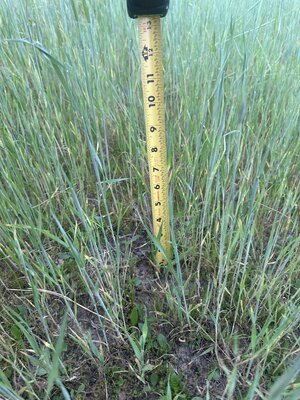
My thread started with a concern that the cereal rye and oats I planted in the fall would not grow to a satisfactory height to provide a decent mat for the regenerative process to work. End of March, we are in a severe drought in my area of Louisiana, and look where my plot is. I do not have a drill. My plan is to broadcast deer vetch, alyce clover, and buckwheat into the standing rye in late May. I will then terminate the rye with a heavy cultipacker. What are your thoughts? Is this going to work? Remember, I am “poor dirt-poor budget.” I do not want to buy a high dollar grain drill, I do not want to buy lime or high dollar fertilizer. I want to build my soil.
 

Attachments

  • IMG_3632.jpeg
    IMG_3632.jpeg
    2.8 MB · Views: 5
If the summer continues to be as this spring, I’d go with pinto beans instead of buckwheat, the beans will survive a somewhat dry Louisiana summer but the buckwheat probably won’t.
 
My thread started with a concern that the cereal rye and oats I planted in the fall would not grow to a satisfactory height to provide a decent mat for the regenerative process to work. End of March, we are in a severe drought in my area of Louisiana, and look where my plot is. I do not have a drill. My plan is to broadcast deer vetch, alyce clover, and buckwheat into the standing rye in late May. I will then terminate the rye with a heavy cultipacker. What are your thoughts? Is this going to work? Remember, I am “poor dirt-poor budget.” I do not want to buy a high dollar grain drill, I do not want to buy lime or high dollar fertilizer. I want to build my soil
@cutman provides good advice. Limit your expectations. You can build good soil over time without fertilizer, but you need to get the pH right for a food plot. If you are unwilling to use lime, I would change my approach completely and manage for weeds. Here is a great thread on it. The video is well worth watching: Weed Management Thread
 
Actually, I am thinking my rye/oats being a foot high at this point in the spring is not bad. How tall should it be at termination time? We have rain predicted next week and hopefully the good Lord will give us moisture. I do understand that soil building is a long term commitment. Hoping for opinions on my start.
 
Actually, I am thinking my rye/oats being a foot high at this point in the spring is not bad. How tall should it be at termination time? We have rain predicted next week and hopefully the good Lord will give us moisture. I do understand that soil building is a long term commitment. Hoping for opinions on my start.
When winter rye is a foot tall it is rank and not used by deer. It is used by deer in the fall when it is young and tender and through winter when you get warm up periods enough for it to start growing again.

If terminating mechanically, it is not a function of height, but growth stage. The soft dough stage is best for crimping.
 
Back
Top