Pennsylvania used to be a state that was anti-fire, and it was difficult to get a permit to burn, but now the PGC is getting onto the prescribed fire bandwagon. Here is a video clip of the Pennsylvania Game Commission biologists describing the benefits of prescribed fire
My objective with growing corn is threefold; provide natural midwinter deer food when there's snow on the ground, get around the Game Commissions CWD area deer feeding ban, and to save money over buying deer corn.How much success do you have planting deer corn and what is your objective. Maturity or…
I think this is a hugely better approach than using feeders with deer corn for winter support! The corn provides both food and cover for deer and other wildlife. It is not concentrated to help reduce disease transmission. It can be expensive, especially with the high N requirements of corn. Rotating to corn after a clover crops is a great idea to use the banked nitrogen.My objective with growing corn is threefold; provide natural midwinter deer food when there's snow on the ground, get around the Game Commissions CWD area deer feeding ban, and to save money over buying deer corn.
Most years this endeavor is a big success, although I've had some crop failures due to drought and mismanagement. And the saving money part would only work if I'd use cheaper equipment.
Are you cutting any of your corn during the season? Mine stays standing and is picked a little at a time during the season (farmer sells what is picked). But, I haven't been too impressed with the attraction of standing corn the last couple of years. It could be the location it's planted in though or something else.My objective with growing corn is threefold; provide natural midwinter deer food when there's snow on the ground, get around the Game Commissions CWD area deer feeding ban, and to save money over buying deer corn.
Most years this endeavor is a big success, although I've had some crop failures due to drought and mismanagement. And the saving money part would only work if I'd use cheaper equipment.
You are right, while not neccessarily the absolute best in all areas, when averaging the total benefits for wildlife food plots, corn is king, although strong arguments could be made for such longterm standby's such as soybeans or clover.I think this is a hugely better approach than using feeders with deer corn for winter support! The corn provides both food and cover for deer and other wildlife. It is not concentrated to help reduce disease transmission. It can be expensive, especially with the high N requirements of corn. Rotating to corn after a clover crops is a great idea to use the banked nitrogen.
I even saw a cool approach for planting direct into clover. There was a sprayer attached to the drill. Each spray head was a narrow spray directly on each planting row. The ended up with a beautiful clover field with small strips of dead clover where the corn was planted. The corn germinated and got above the clover before it filled in. The corn then helped shade the clover in the summer and the clover provided N for the corn. Seemed like a great idea to me for those planting corn.
I usually cut shooting lanes though the standing corn by one method or the other. Cutting early shooting lanes and planting those lanes in clover/ grain/ brassicas etc. is a popular method. During the fall/ winter as the deer clean up the downed corn, the openings through the field are chopped wider. (Check your local regulations about the legality of hunting over chopped corn)Are you cutting any of your corn during the season? Mine stays standing and is picked a little at a time during the season (farmer sells what is picked). But, I haven't been too impressed with the attraction of standing corn the last couple of years. It could be the location it's planted in though or something else.
That's exactly my experience, even the part about them being rough on corn while it's younger and growing. They can do a number on it. I have no idea why they don't come to it as much when it's still up. Makes no sense to me. But, you're absolutely right.You are right, while not neccessarily the absolute best in all areas, when averaging the total benefits for wildlife food plots, corn is king, although strong arguments could be made for such longterm standby's such as soybeans or clover.
I'd like to try that spray idea, it sounds like a real winner. The only obvious downside is that it's not a good idea to bait your deer into the cornfield during the growing season, deer can be very rough on corn.
I usually cut shooting lanes though the standing corn by one method or the other. Cutting early shooting lanes and planting those lanes in clover/ grain/ brassicas etc. is a popular method. During the fall/ winter as the deer clean up the downed corn, the openings through the field are chopped wider. (Check your local regulations about the legality of hunting over chopped corn)
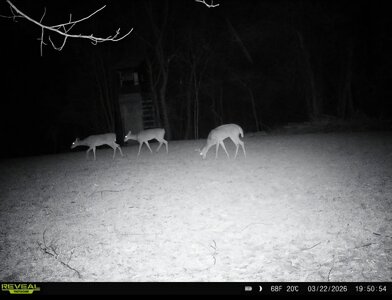
The "why" of it remains a mystery to me, but deer vastly prefer to eat their corn on the ground, and sometimes will actually not eat corn on the stalk. One year I checked my cornfield in mid February and was shocked to discover that half of the 4 acre corn crop was still standing with the ears hanging and no deer activity. I quickly got the brush hog out and chopped it down, and the for next several weeks the cameras showed it looking like a deer and turkey pen, and within three weeks the last kernel was cleaned up. Go figure?
Looks great! You plan on overseeding rye again this fall?The magic of rye and clover!
The best one two punch for deer food plots ever. Here are two 1 acre shooting plots that have ladino clover in them, and I fall, seeded rye during the drought last October. Even with the drought, the rye germinated and fed the deer herd over winter. Now I am going to let the rye go into straw to use up my excess nitrogen, then, I will mow it and spray the plot for weeds soon thereafter.
Yes, for my permanent small ladino clover plots I almost always inter-seed fall rye to boost the food plot. If I miss the opportunity I usually inter-seed spring oats instead to provide carbon and use up nitrogen. I broadcast cereal rye at 200 lbs per acre, then I mow the clover short on top of the newly seeded rye to give it a chance to germinate. Then I sometimes pull a tooth drag through behind the mower if there's a heavy thatch because rye seed germinates best with seed to soil contact. I usually seed right around labor day. Seeding right before a rain increases the success rate of this seeding.Looks great! You plan on overseeding rye again this fall?
Do you overseed or drill the oats? Have any thoughts on barley?Yes, for my permanent small ladino clover plots I almost always inter-seed fall rye to boost the food plot. If I miss the opportunity I usually inter-seed spring oats instead to provide carbon and use up nitrogen. I broadcast cereal rye at 200 lbs per acre, then I mow the clover short on top of the newly seeded rye to give it a chance to germinate. Then I sometimes pull a tooth drag through behind the mower if there's a heavy thatch because rye seed germinates best with seed to soil contact. I usually seed right around labor day. Seeding right before a rain increases the success rate of this seeding.
I do it exactly the same as you with great results!Yes, for my permanent small ladino clover plots I almost always inter-seed fall rye to boost the food plot. If I miss the opportunity I usually inter-seed spring oats instead to provide carbon and use up nitrogen. I broadcast cereal rye at 200 lbs per acre, then I mow the clover short on top of the newly seeded rye to give it a chance to germinate. Then I sometimes pull a tooth drag through behind the mower if there's a heavy thatch because rye seed germinates best with seed to soil contact. I usually seed right around labor day. Seeding right before a rain increases the success rate of this seeding.
I do both, and drilling is of course the best option, but I have over-seeded oats in early spring with great success. My greatest successes with over-seeding oats in the spring have usually been with getting it done in late March or early April. By May there can be hot and dry spells which lead to planting failures, in May you need to inter-seed right before a rain and also mow short afterwards for good oats germination rates.Do you overseed or drill the oats? Have any thoughts on barley?