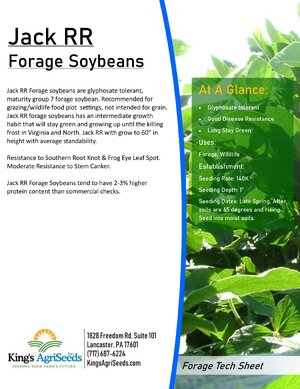
JACK ROUNDUP READY SOYBEANS

Mennoniteman

Well-Known Member
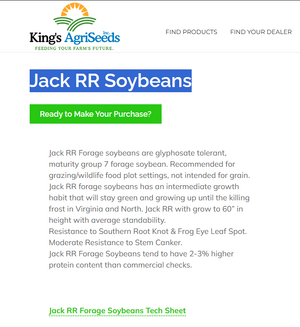
Forage soybeans for deer are the bee's knees, and I've been growing Titan brand beans for quite a few years, but in the past several years I'm having trouble finding these in stock. Now this year there were none available locally, and shipping is going to make them unaffordable, but I've found a new brand, "Jack RR Forage Soybeans" for sale at my local seed supplier, King's Agriseeds. I'm not sure if this is a King's branded seed of if these are national, I've not been able ot find a website, but I do have 12 bags in my possession.
So I'm going to give these Jack beans a try and see what the result is like, hopefully I'll have something to report back later.
1777477930875.png
 
Back when I was planting forage beans, I was using Eagle brand. The cost and availability of these was one of the factors that caused me to stop planting them. I ended up switching to a mix of buckwheat and sunn hemp for my spring plant. One of the problems I had was how many acres I needed to plant before the beans would canopy. I think timing was an issue as well. If I planted enough and caught the timing just right (and the weather cooperated) there was a window where the beans could establish while does were fawning in heavy cover. Once fawns hit the ground, the beans were hammered by does and fawns. Because buckwheat likes warm soil and comes up so fast, It tolerates browsing much better. It also helps hide the sunn hemp until it can handle the browse pressure. Sunn hemp has similar nutritional value to soybeans. Deer use these plots daily, but they don't wipe them out even with smaller plots.

Let us know how the price is on these. If the cost is reasonable, I may try forage beans again at my retirement property which has lower deer densities than the farm.
 
Back when I was planting forage beans, I was using Eagle brand. The cost and availability of these was one of the factors that caused me to stop planting them. I ended up switching to a mix of buckwheat and sunn hemp for my spring plant. One of the problems I had was how many acres I needed to plant before the beans would canopy. I think timing was an issue as well. If I planted enough and caught the timing just right (and the weather cooperated) there was a window where the beans could establish while does were fawning in heavy cover. Once fawns hit the ground, the beans were hammered by does and fawns. Because buckwheat likes warm soil and comes up so fast, It tolerates browsing much better. It also helps hide the sunn hemp until it can handle the browse pressure. Sunn hemp has similar nutritional value to soybeans. Deer use these plots daily, but they don't wipe them out even with smaller plots.

Let us know how the price is on these. If the cost is reasonable, I may try forage beans again at my retirement property which has lower deer densities than the farm.
I paid $71.00 a bag, seed rate is one bag per acre if drilled, 1.5 if conditions aren't ideal, 2 bags per acre if broadcast or drilled in smaller plots in high deer density areas.
 
I have to use enlist ready beans in the fight with marestail and pigweed.I may have see if there are any forage SB around.I have some long term seed 4/6. But my ag fields close to my plots just rowed out so I will wait another week or two and maybe my plot will make it this year.It was grazed to the ground and never got taller than 3-4 inches when I had milo close by.
 
I have to use enlist ready beans in the fight with marestail and pigweed.I may have see if there are any forage SB around.I have some long term seed 4/6. But my ag fields close to my plots just rowed out so I will wait another week or two and maybe my plot will make it this year.It was grazed to the ground and never got taller than 3-4 inches when I had milo close by.
Thundermaster kills marestail and pigweed in RR soybeans and doesn't need a license. Imazthapyr 2sl kills marestail and pigweed in non-RR soybeans, but isn't as effective on grasses, it would need to be tank mixed with clethodim to include grass control. Neither one of these options needs enlist soybeans to kill marestail.
 
I have to use enlist ready beans in the fight with marestail and pigweed.I may have see if there are any forage SB around.I have some long term seed 4/6. But my ag fields close to my plots just rowed out so I will wait another week or two and maybe my plot will make it this year.It was grazed to the ground and never got taller than 3-4 inches when I had milo close by
Marestail was the initial reason I switched from RR beans to Sunn Hemp and buckwheat. When we had our first pine thinning, we got a huge crop of Marestail in the thinned pines that invaded our food plots the following year. Planting the RR beans made thing worse. I figured I'd focus on getting rid of the marstail for the next couple seasons.

I switched from Gly to Liberty for the burn down, and had no need for post planting herbicides. This is because the buckwheat is so fast to germinate and grow. It took about 2 seasons for marestail to become just another weed instead of dominating the field. By then, I was so happy with the Sunn hemp and buckwheat mix that I've just kept using it. I now rotate between Liberty and Gly for burndown. Sometimes I mix them.
 
Marestail was the initial reason I switched from RR beans to Sunn Hemp and buckwheat. When we had our first pine thinning, we got a huge crop of Marestail in the thinned pines that invaded our food plots the following year. Planting the RR beans made thing worse. I figured I'd focus on getting rid of the marstail for the next couple seasons.

I switched from Gly to Liberty for the burn down, and had no need for post planting herbicides. This is because the buckwheat is so fast to germinate and grow. It took about 2 seasons for marestail to become just another weed instead of dominating the field. By then, I was so happy with the Sunn hemp and buckwheat mix that I've just kept using it. I now rotate between Liberty and Gly for burndown. Sometimes I mix them.
To prep for corn planting I've been tank mixing Gly and Interline (Liberty) 32 oz per acre each. This mix allows using a lighter application of each chemical and a 100% burndown. AMS and crop oil is key to good results.
 
To prep for corn planting I've been tank mixing Gly and Interline (Liberty) 32 oz per acre each. This mix allows using a lighter application of each chemical and a 100% burndown. AMS and crop oil is key to good results.
That is what I've been doing in years when I mix herbicides for all of my burndowns. I actually used interline (Generic Liberty) myself.
 
Its been a several years since I planted Eagle brand forage beans. I couldn't find any forage soybeans this year to try at my local seed dealers. I did find a dealer for Eagle brand an hour away so I made trip over there this week and picked up a couple of bags. I am going to have to fence them until they maybe get knee high and then I am hoping I can drop the fence and the forage beans will be able to keep up with the deer.
 
Its been a several years since I planted Eagle brand forage beans. I couldn't find any forage soybeans this year to try at my local seed dealers. I did find a dealer for Eagle brand an hour away so I made trip over there this week and picked up a couple of bags. I am going to have to fence them until they maybe get knee high and then I am hoping I can drop the fence and the forage beans will be able to keep up with the deer.
Back when I first started planting eagle beans, my partners thought I was doing something wrong when planting them because they never got more than a few inches tall and never canopied. I put up a Gallagher-style e-fence up around about 1 acre of the beans. Those inside the fenced area got chest high. Those outside never canopied. It was all browse pressure!
 
Back when I first started planting eagle beans, my partners thought I was doing something wrong when planting them because they never got more than a few inches tall and never canopied. I put up a Gallagher-style e-fence up around about 1 acre of the beans. Those inside the fenced area got chest high. Those outside never canopied. It was all browse pressure!
Mississippi State University (MSU) experts, alongside the MDWFP, have frequently indicated that Mississippi's deer population is very high, often cited at over 33 deer per square mile. To maintain healthy herds and habitat, experts generally recommend managing for a lower density, with optimal numbers often suggested closer to 15–25 deer per square mile depending on habitat quality.
We're in the middle of a year's long program to get our deer numbers closer to MSU recommendations, which should help the grazing pressure.
"There's nothing more satisfying for a deer habitat fanatic than watching a late summer bachelor group of bucks in velvet in a bean field"
 
You really got to love MSU's deer lab. Their podcasts are outstanding. They are able to take some of the latest scientific research and make down to earth presentations of just how they relate to practical hands-on deer management. Over the years they have debunked a lot of "common knowledge" about deer.
 
Back
Top