
-
The forum has been upgraded to support both light and dark themes. Click here for directions.
You are using an out of date browser. It may not display this or other websites correctly.
You should upgrade or use an alternative browser.
You should upgrade or use an alternative browser.
Is the rut this perplexing in your state?
- Thread starter 1100LT20
- Start date

Native Hunter
Well-Known Member
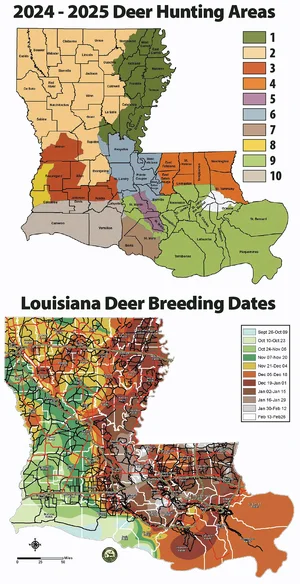
My guess is that it probably isn't even correct. Our state put this one out, and it isn't even close for where I hunt:

1100LT20
Well-Known Member
Was Kentucky restocked with whitetail deer in the past? Louisiana was in the 1950’s with deer from Wisconsin, Texas and Mississippi according to LDWF records. This along with intense hunting pressure in isolated areas is what causes these variations…at least that’s my silly hypothesis, lol.My guess is that it probably isn't even correct. Our state put this one out, and it isn't even close for where I hunt:
Native Hunter
Well-Known Member
Was Kentucky restocked with whitetail deer in the past? Louisiana was in the 1950’s with deer from Wisconsin, Texas and Mississippi according to LDWF records. This along with intense hunting pressure in isolated areas is what causes these variations…at least that’s my silly hypothesis, lol.
Yes, it was restocked at some point. Do you feel that the map for your state is accurate?
1100LT20
Well-Known Member
Accurate to the areas I’ve hunted which is 2, 4, 6 and 9. But have also seen active scraping activity in early March in an area where biologists say peak rut is early January? This was also a high pressure hunting lease and maybe the deer just laid low until we all exited for the season’s end?Yes, it was restocked at some point. Do you feel that the map for your state is accurate?
Native Hunter
Well-Known Member
I have a pretty good feel for when breeding happens here, because I frequently set in the stand and watch it happen.Accurate to the areas I’ve hunted which is 2, 4, 6 and 9. But have also seen active scraping activity in early March in an area where biologists say peak rut is early January? This was also a high pressure hunting lease and maybe the deer just laid low until we all exited for the season’s end?
BenAllgood
Well-Known Member
I've hunted in 2, 4, 6, an 9 also. Those dates do seem to line up with what I've seen. The LDWF have done lots of sampling all across these areas where they pull fetuses and measure to back date when they were bred.
In Kentucky, you have much more visibility than most of the places I've hunted in Louisiana. The rut is much more visible there from my experience. I thought the November 21st, Kentucky average for the peak breeding date was pretty accurate. I saw activity ramp up about a week before that and then again a week after. But, I could be wrong about the dates. Native has a lot more time in the stand than I do up there.
In Kentucky, you have much more visibility than most of the places I've hunted in Louisiana. The rut is much more visible there from my experience. I thought the November 21st, Kentucky average for the peak breeding date was pretty accurate. I saw activity ramp up about a week before that and then again a week after. But, I could be wrong about the dates. Native has a lot more time in the stand than I do up there.

yoderjac
Well-Known Member
In the north, with the shorter growing season, the rut peak is sharper as fawns need enough time to develop before their first winter. It is much easier measure that peak. In the south, breeding can be much more drawn out. With a broader and lower peak, it takes a much larger sample to have an accurate picture. I'm guessing that it would be difficult to get enough samples to have a map as accurate as the picture seems to show.
BenAllgood
Well-Known Member
Louisiana has a very strong working DMAP program. Lots of clubs take advantage of this. They have a huge dataset to draw from. I went to drop off jawbones one time and there was a very large conference room with envelopes of jawbones everywhere. This was for one area, and there were thousands and thousands. They also send biologists to do browse surveys to help with doe tag allotments. I've tagged along on a few of these. They also come out and measure fawn fetuses. This is where they get that rut data. In that picture, you can see radiating circles in some places. The center is where they have gathered the most data. Also, in Louisiana, the breeding period is delayed so fawns will be born after the spring floods in some areas. In other areas, does have historically held onto the breeding dates of where they originated from. It makes a mess of maps, but it gives someone the opportunity to hunt the rut all season long if they want just by moving around the state.In the north, with the shorter growing season, the rut peak is sharper as fawns need enough time to develop before their first winter. It is much easier measure that peak. In the south, breeding can be much more drawn out. With a broader and lower peak, it takes a much larger sample to have an accurate picture. I'm guessing that it would be difficult to get enough samples to have a map as accurate as the picture seems to show.
yoderjac
Well-Known Member
Ben, do they have another way to determine breeding other than measuring fetuses? That is the only way I know, and you would need to kill a lot of does to get a good dataset with such diversity in dates. Who knows, with technology today, maybe they have another method.
BenAllgood
Well-Known Member
Not that I'm aware of. They have a strong relationship with many clubs and landowners across the state. It's like a crowd sourced dataset. Another thing that helps is the way a lot of people handle the deer they kill down here. I haven't seen alot of gutted in the field deer. Most deer are brought back to a central cleaning shed on the club. The biologists just come to the shed and do a quick measurement. They move on to the next club. Some are obtained on WMAs whenever they employ mandatory check stations.Ben, do they have another way to determine breeding other than measuring fetuses? That is the only way I know, and you would need to kill a lot of does to get a good dataset with such diversity in dates. Who knows, with technology today, maybe they have another method.

Fishman
Active Member
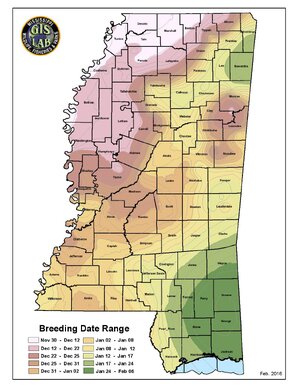
I live in Mississippi but hunt in area 4 in Louisiana. The Louisiana map is pretty accurate for this area. You will see newborn fawns around here in August. I have seen spotted fawns into mid November. Here is the map for Mississippi and the dates align closely in the “boot” area.

weekender21
Well-Known Member
NC is right below the latitude line where the whitetail rut becomes so predictable. Peak ruts in NC can be as early as October (coast) or as late as December in the extreme western side of the state. The NC rut map is based on fetus measurements which is supposed to be the most reliable.
Sent from my iPhone using Tapatalk
Sent from my iPhone using Tapatalk

Deadeye
Well-Known Member
Y'all want to see Crazy- Take a look at Florida Ruts!!!
Florida is split into 4 Hunting Zones. In South Florida they start hunting Archery in June and the Rut hits about the same time.
In NW Florida the last Gun Season goes out the end of February!! The Rut there in the Panhandle varies by County- even within some Counties there is variation.
Where we had our Lease in Washington (lost the only access road to it this year) the Rut hit the hardest the 2nd week of February, yet neighboring Counties had it in Early January- Mid January- End of January- 1st week of February- 3rd Week of February and End of February.
I had pics of Newly Dropped Fawns that could barely walk in Late August- do the math.
Florida is split into 4 Hunting Zones. In South Florida they start hunting Archery in June and the Rut hits about the same time.
In NW Florida the last Gun Season goes out the end of February!! The Rut there in the Panhandle varies by County- even within some Counties there is variation.
Where we had our Lease in Washington (lost the only access road to it this year) the Rut hit the hardest the 2nd week of February, yet neighboring Counties had it in Early January- Mid January- End of January- 1st week of February- 3rd Week of February and End of February.
I had pics of Newly Dropped Fawns that could barely walk in Late August- do the math.
Similar threads

- Replies
- 13
- Views
- 648


